
DNA and Ancestry Test: What Your Results Can Reveal
DNA and Ancestry Tests: What They Can—and Can’t—Tell You
DNA ancestry tests offer a way to explore family history through genetic information. By comparing parts of a person’s DNA with reference data from people whose ancestors came from different regions, testing companies estimate where some of that person’s ancestors may have lived. Many services also identify genetic matches—other customers who may share DNA and be related.
These tests can be an interesting starting point for family-history research, but their results are estimates, not a complete record of someone’s ancestry. Understanding how testing works, what the results mean, and how personal genetic information is handled can help people use these tools thoughtfully.
How ancestry DNA testing works
Most ancestry tests analyze a sample of saliva or cells collected with a cheek swab. The laboratory examines selected genetic markers and compares them with data from reference groups. The company then uses its analysis methods to estimate how a person’s DNA resembles those groups.
Some tests also look for shared DNA segments between customers. Because relatives inherit DNA from common ancestors, these similarities can point to possible family relationships. A match might be a close relative, a distant cousin, or someone whose relationship is difficult to determine without additional research.
Understanding ethnicity estimates
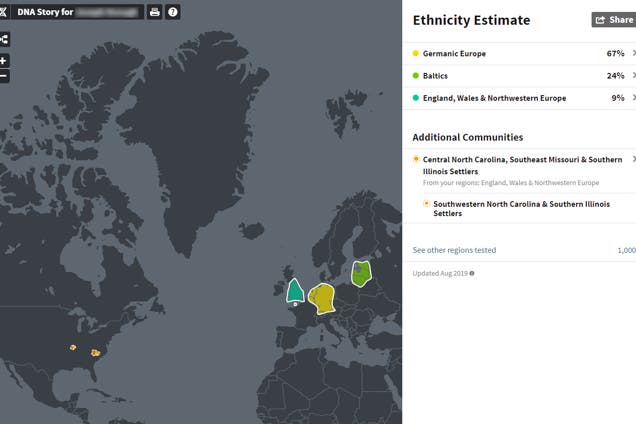
An ethnicity estimate may divide a person’s DNA into percentages associated with geographic regions or populations. These categories are based on the company’s reference samples and definitions, which differ from one provider to another. As databases grow and analysis methods change, estimates may also be updated.
It is best to treat these percentages as clues rather than exact measurements of identity or nationality. Populations have moved, mixed, and changed over many generations, and modern national borders do not always match historical communities. A test may identify a broad genetic similarity without pinpointing a specific town, country, or ancestor.
Finding relatives through DNA matches
DNA matching can help confirm or uncover family connections. A match may provide a name, family tree, or location that offers a new direction for research. However, a shared DNA result does not always reveal precisely how two people are related. Family records, dates, locations, and conversations with relatives can help clarify the connection.
Unexpected matches can also reveal information that a family did not know or was not prepared to learn, such as an unknown parent or a previously undisclosed adoption. Before testing, consider whether you and your relatives are comfortable with the possibility of unexpected discoveries.
Using DNA results with traditional research
DNA testing is most useful when combined with documentary evidence. Census records, birth and death certificates, church registers, newspapers, land records, military files, and family correspondence can help place genetic clues in historical context.
Start with a specific research question, such as identifying the parents of a particular ancestor or learning whether two family lines are connected. Keep notes about the evidence, distinguish confirmed facts from theories, and avoid changing a family tree based on one match or an ethnicity estimate alone.
Privacy and data considerations
Genetic information is personal and may also reveal details about biological relatives. Before ordering a test, read the company’s privacy policy and learn how it stores, uses, and shares samples and data. Check whether research participation is optional, how to manage match visibility, and whether data or a sample can be deleted upon request.
Think carefully before uploading raw DNA data to other services. Each service may have different security practices and terms. It can also be helpful to discuss testing with close relatives, particularly when results could affect their privacy or reveal unexpected family information.
Choosing a test
Different companies offer different databases, features, geographic coverage, and privacy options. Consider what you hope to learn, whether the service has useful tools for family matching, and what happens to your data after testing. No single test can provide a complete account of a person’s heritage.
A useful tool, not the whole story
DNA ancestry tests can bring new leads to family-history research and help connect people with relatives. Their results are most meaningful when interpreted carefully and supported by records, family knowledge, and historical context. DNA can offer a valuable piece of the story, while the work of understanding that story continues through research and thoughtful questions.
Understanding DNA and Ancestry Tests: Top 7 Questions Answered
- Why do I only share 47% DNA with my dad?
- Is ancestry free with DNA test?
- Why was 23andMe shut down?
- Which is better, 23andMe or Ancestry?
- How accurate is the ancestry DNA test?
- Which DNA test is most accurate for ethnicity?
- Is an ancestry test the same as a DNA test?
Why do I only share 47% DNA with my dad?
Sharing 47% of your DNA with your dad can be normal: a child inherits roughly half of their autosomal DNA from each parent, but natural variation in how DNA is passed down can make the percentage a little higher or lower. Check what the test is measuring, since an ethnicity estimate is different from the amount of DNA shared with a relative. If the result is far below the expected parent-child range, or you have concerns about the relationship, contact the testing company and consider confirming it with an accredited relationship test.
Is ancestry free with DNA test?
Ancestry information is usually included when you purchase a DNA test, but the test itself is not typically free. The price may cover an ethnicity estimate and DNA matches, while access to some family-tree records, research tools, or advanced features may require a separate subscription. What’s included varies by provider, so check the current pricing and plan details before ordering.
Why was 23andMe shut down?
23andMe wasn’t simply shut down: in March 2025, it filed for Chapter 11 bankruptcy protection after financial difficulties, including declining demand and concerns following a 2023 data breach. A court-approved sale transferred the company’s assets to TTAM Research Institute, founded by 23andMe co-founder Anne Wojcicki, and its consumer DNA services were not immediately discontinued. The bankruptcy did, however, raise questions about who would control customers’ genetic data, so customers should check the company’s current privacy policies and account options.
Which is better, 23andMe or Ancestry?
Neither 23andMe nor Ancestry is better for everyone—it depends on what you hope to learn. AncestryDNA is often a strong choice for family-history research because of its large relative-matching network and links to family trees and historical records, though some features may require a subscription. 23andMe offers ancestry estimates and relative matching, and has also offered health-related reports in some regions and plans; availability can change, so check its current services and privacy terms. Both companies’ ethnicity estimates are approximations, and their databases and tools differ. Compare the features, costs, matching options, and data policies that matter most to you before choosing.
How accurate is the ancestry DNA test?
An ancestry DNA test can provide useful estimates, but its accuracy depends on what it measures and the company’s reference database. Genetic relative matching is often more informative than ethnicity percentages, though relationships may still need to be confirmed with family records. Ethnicity estimates are not exact, can vary between companies, and may change as databases and analysis methods are updated. Treat results as clues about your ancestry—not definitive proof of a specific identity, location, or family connection.
Which DNA test is most accurate for ethnicity?
No single DNA test is the most accurate for everyone’s ethnicity estimates. Results depend on each company’s reference populations, geographic coverage, and methods, so estimates can differ and may change as databases are updated. For the most useful comparison, look for a provider with strong reference data for the regions relevant to your family history, and treat the percentages as estimates rather than definitive proof of nationality or identity. DNA matches and historical records can offer additional clues, but ethnicity estimates alone cannot identify every ancestor or exact place of origin.
Is an ancestry test the same as a DNA test?
An ancestry test is a type of DNA test, but not all DNA tests focus on ancestry. Ancestry tests analyze genetic markers to estimate geographic origins and identify possible biological relatives. Other DNA tests may be designed to provide health-related information, establish biological relationships, or support medical research. Before choosing a test, check what it analyzes and how the company handles your genetic data.